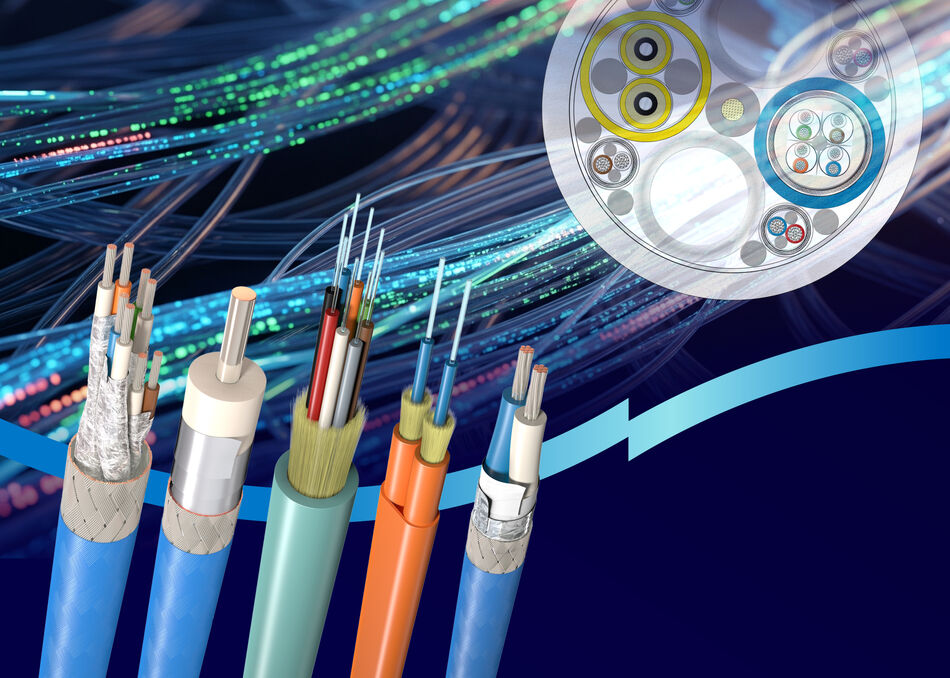
Fiber Optics
For applications demanding the highest possible bandwidth and absolute immunity to electromagnetic interference (EMI), fiber optics remains the gold standard. Transmitting data as light pulses through thin glass or plastic strands, fiber optic cables offer:
- Maximum bandwidth: Capable of transmitting data at 100 Gbit/s and beyond, fiber optics is uniquely positioned for uncompressed 8K+ video transmission, massive data transfers from high-resolution detectors, and high-speed backbone connections within medical facilities.
- EMI immunity: Unlike copper, fiber optic cables are completely unaffected by electrical noise, ensuring unaffected signal integrity in electromagnetically noisy environments such as MRI suites or operating rooms with numerous electronic devices.
- Long distance: Fiber can transmit data over kilometers without significant signal degradation, eliminating the need for repeaters over typical hospital distances.
- Flexibility & robustness: While traditionally perceived as fragile, BizLink supplies UL-recognized fiber optic cables, particularly with bend-insensitive and X-ray resistant fibers, offering remarkable flexibility and durability. Advanced constructions with robust jacketing and internal strengthening elements can be engineered to withstand rigorous mechanical stress, making them viable for dynamic applications like robotic guidance.
Ethernet
Copper-based Industrial Ethernet cables (Cat 5e, 6, and 7) continue to play an important role. Building upon regular Ethernet, Bizlink’s FieldLink Industrial Ethernet cables for medical equipment offer good bandwidth (up to 10 Gbit/s for Cat 7) over standard distances (up to 100 meters), while being specifically engineered for secure (typically UL-recognized) and reliable use in demanding environments. They feature robust jackets that are biocompatible, resist abrasion, bending, torsion, pulling or compression forces, oils, chemicals, and extreme temperatures.
Being carefully shielded, they are not susceptible to EMI. Specialized versions offer enhanced flexibility for dynamic applications like drag chains or robotic movements. They can also support Power over Ethernet (PoE), providing both data and power.
Single Pair Ethernet (SPE)
Emerging from the demanding environments of the automotive and industrial sectors, SPE represents a significant leap in copper-based connectivity. Its core innovation lies in reducing the Ethernet transmission to a single twisted pair of copper wires, a strong contrast to the two or four pairs used in conventional Ethernet. This fundamental design choice yields substantial benefits for medical imaging:
- Space & weight: The reduced conductor count makes SPE cables remarkably thin and lightweight, enabling unprecedented miniaturization in portable and integrated imaging devices. This is crucial for fitting complex wiring into compact housings and reducing the overall burden on mobile equipment.
- Flexibility: The simpler construction inherently provides superior flexibility. This makes BizLink’s UL-recognized SPE cables an ideal candidate for applications requiring continuous, dynamic movement, such as within robotic arms that guide imaging probes or in drag chains of C-arms. Specialized jacket materials further enhance their resilience against oil and harsh cleaning agents common in medical settings.
- Power over Data Line (PoDL): BizLink SPE cables support PoDL, allowing both data and power to be transmitted over the same single pair. This simplifies cabling infrastructure, reduces the number of connectors, and streamlines installation, contributing to a cleaner and more efficient device design.
- Bandwidth: While SPE cables offer impressive data rates up to 1 Gbps (1000BASE-T1) over 40 meters, and 10 Mbps (10BASE-T1L) over 1,000 meters, their bandwidth is generally lower than fiber optics or traditional Ethernet. This means it is highly suitable for many sensor-to-processor data streams and compressed video, but may not suffice for uncompressed, ultra-high-resolution real-time imaging like 8K VR.
Parallel pair high-speed
For specific internal machine connections with short-distance high-bandwidth needs in switchboard or server units, BizLink’s ParaLink parallel pair high-speed cables offer a unique set of benefits.
These cables can achieve very high data rates (224 Gbit/s for ParaLink 60s) over short distances. Their parallel construction allows for a very compact form factor within a device. Their performance is highly dependent on precise impedance matching and careful routing to avoid crosstalk. They are generally not designed for external, dynamic applications with repeated flexibility needs or long distances.
HDMI, DisplayPort, USB-C
BizLink offers many video cables primarily designed for direct device-to-display connections. HDMI and DisplayPort cables offer high bandwidth for uncompressed video (up to 48 Gbit/s for HDMI 2.1 and up to 80 Gbit/s for DisplayPort 2.1), making them suitable for connecting imaging consoles to high-resolution monitors. USB-C is a highly versatile connector that, through Alt Modes (e.g., DisplayPort Alt Mode), can carry high-resolution video, high-speed data, and power over a single cable. This simplifies connectivity for portable devices.
In addition to its broad portfolio of standard video cables, BizLink supplies HDMI, DisplayPort and USB-C cables designed for high-density, extreme flexibility, repeated dynamic movement, or harsh environmental conditions found within integrated medical device wiring. BizLink also supplies custom molded connectors, which are optimized for internal routing.
Coaxial
While many standards are applying fiber optic or twisted pair solutions, coaxial cables remain crucial for specific, specialized medical applications, most notably where signal integrity in unique environments is paramount:
- Bandwidth & quality: While not inherently immune to EMI, their concentric conductor/shield design offers a high degree of predictable signal integrity and shielding for RF applications, making them beneficial in controlled, electromagnetically sensitive scenarios. Non-magnetic BizLink multicoaxial cables play a significant role in MRI, connecting the coils with the computer system.
- Size & complexity: BizLink’s coaxial and multicoaxial cables are characterized by their small dimensions (up to AWG 40). Their compact design makes them flexible for use even in mobile applications, overcoming the general industry limitation of stiffness.
- Limited functionality: Despite their excellent specialized capabilities, they generally offer lower bandwidth than fiber optics and are unsuitable for ultra-high-resolution digital imaging and massive data transfer.
Overcoming Limitations Through Custom Design
The complexity of modern medical imaging devices means that no single cable standard is a universal solution. The true advantage lies in the ability to custom-design connectivity solutions that strategically leverage the strengths of each technology while mitigating its inherent limitations. This involves:
- Hybrid cables: Combining different cable types (e.g., fiber optics for high-speed data, copper for power or low-speed signals, even air/fluid tubes) within a single, optimized jacket to achieve maximum functionality in a minimal footprint.
- Advanced materials & construction: Utilizing specialized jacket materials, shielding techniques, and stranding designs to enhance flexibility, durability, and EMI performance beyond standard specifications.
- Optimized routing & connectors: Designing cable assemblies with precise routing, strain relief, and custom connectors that are perfectly matched to the device's mechanical and electrical requirements, ensuring longevity in dynamic applications.
- Integrated solutions: Developing complete cable subsystems that are pre-assembled and tested, simplifying integration for OEMs and ensuring consistent performance.
By embracing this tailored approach, medical device engineers can transcend the limitations of off-the-shelf components, unlocking the full potential of advanced imaging technologies and ensuring reliable, high-performance operation in the most demanding healthcare environments.